LimitedBlend

You must be at least 21 to visit this site. Please enter your date of birth.
100 mg / pen
Four decades of research in collagen synthesis — research pen
1 box · 100 mg per pen
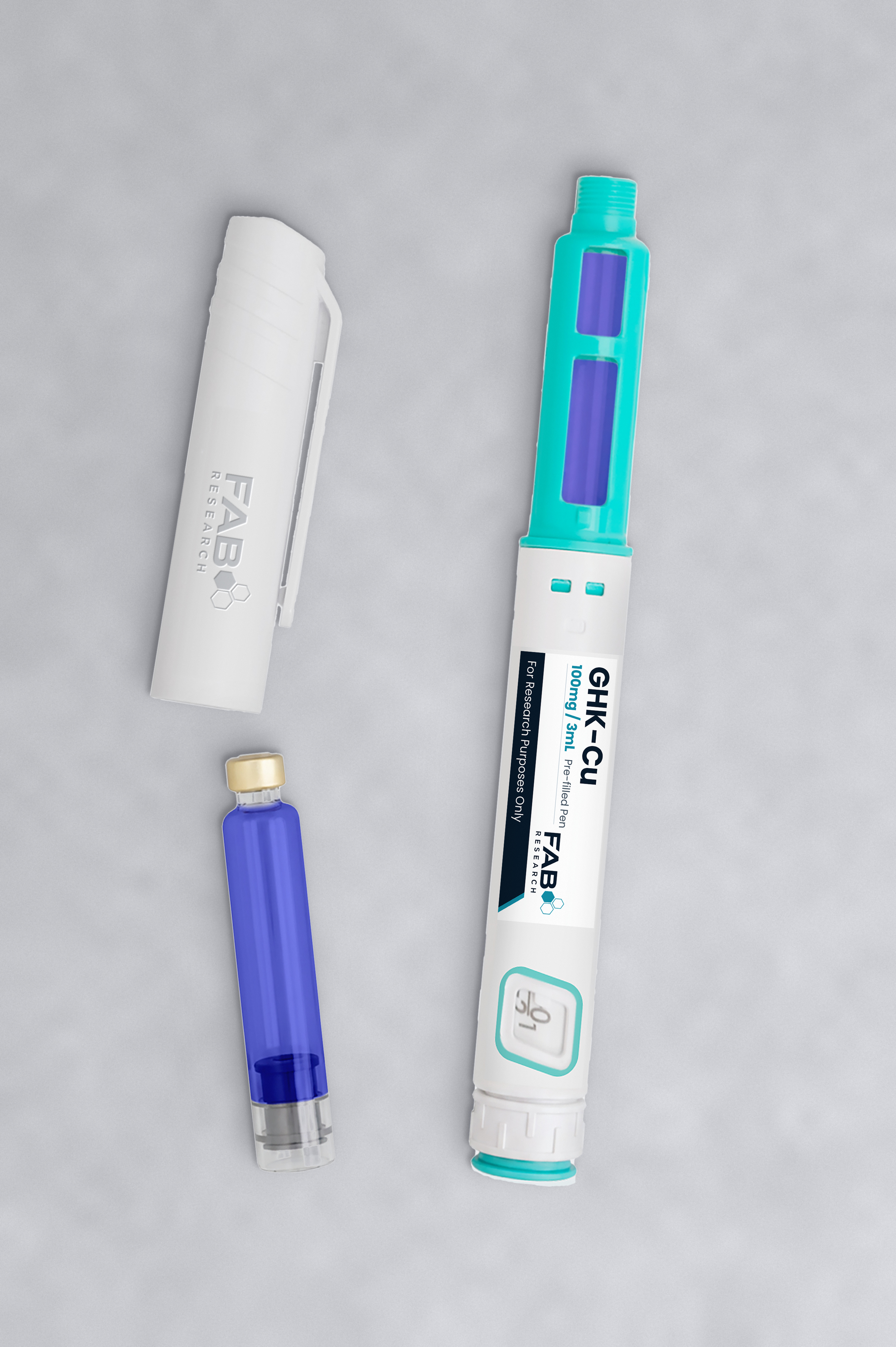
GHK-Cu copper peptide is a naturally occurring peptide-derived copper complex investigated for its involvement in collagen synthesis, extracellular matrix regulation, skin physiology and cellular signalling. Also known as copper tripeptide-1, it consists of the tripeptide glycyl-L-histidyl-L-lysine (GHK) associated with a copper(II) ion. GHK-Cu has been the subject of scientific research for several decades, including laboratory investigations into fibroblast activity, collagen production, matrix metalloproteinase regulation and cellular responses to tissue injury. The characteristic blue colour arises from the copper complex. FAB Research supplies GHK-Cu in a 100mg pre-filled metered research pen for laboratory investigation.
Sequence GHK·Cu(II)
GHK-Cu's biological activity is associated with several interconnected molecular processes. Research has investigated its role in collagen synthesis through fibroblast cultures, matrix metalloproteinase regulation affecting the balance between matrix synthesis and degradation, copper-dependent cellular enzyme processes, changes in gene-expression patterns associated with inflammatory signalling and extracellular matrix biology, and fibroblast and keratinocyte activity in experimental skin models. Its precise effects depend on the chemical form, copper coordination state, concentration and experimental conditions.
GHK-Cu has an established scientific history spanning molecular biology, dermatological research and selected human studies involving topical formulations. A study published in FEBS Letters in 1988 examined GHK-Cu in human fibroblast cultures and reported increased collagen synthesis — this helped establish the compound as a subject of interest in connective tissue biology. Small human cosmetic studies have reported changes in skin firmness, texture and the appearance of fine lines following topical use. However, the human evidence base is limited and varies considerably in study quality. Findings from topical cosmetic formulations cannot establish the safety or biological activity of a different delivery format.
Storage: Store refrigerated at 2–8 °C in the original sealed box. Do not freeze. Protect from light.
Effects listed are observations from published research literature and are not predictions for any specific use. All FAB Research products are for in-vitro laboratory research — not for human or animal administration.
Research applications are provided for informational context only and do not constitute a recommendation for any use.
No reviews for GHK-Cu 100 mg yet. Have you received it? Share your experience with other researchers.
Reviews from customers who have received GHK-Cu 100 mg will appear here.
Same research pathway